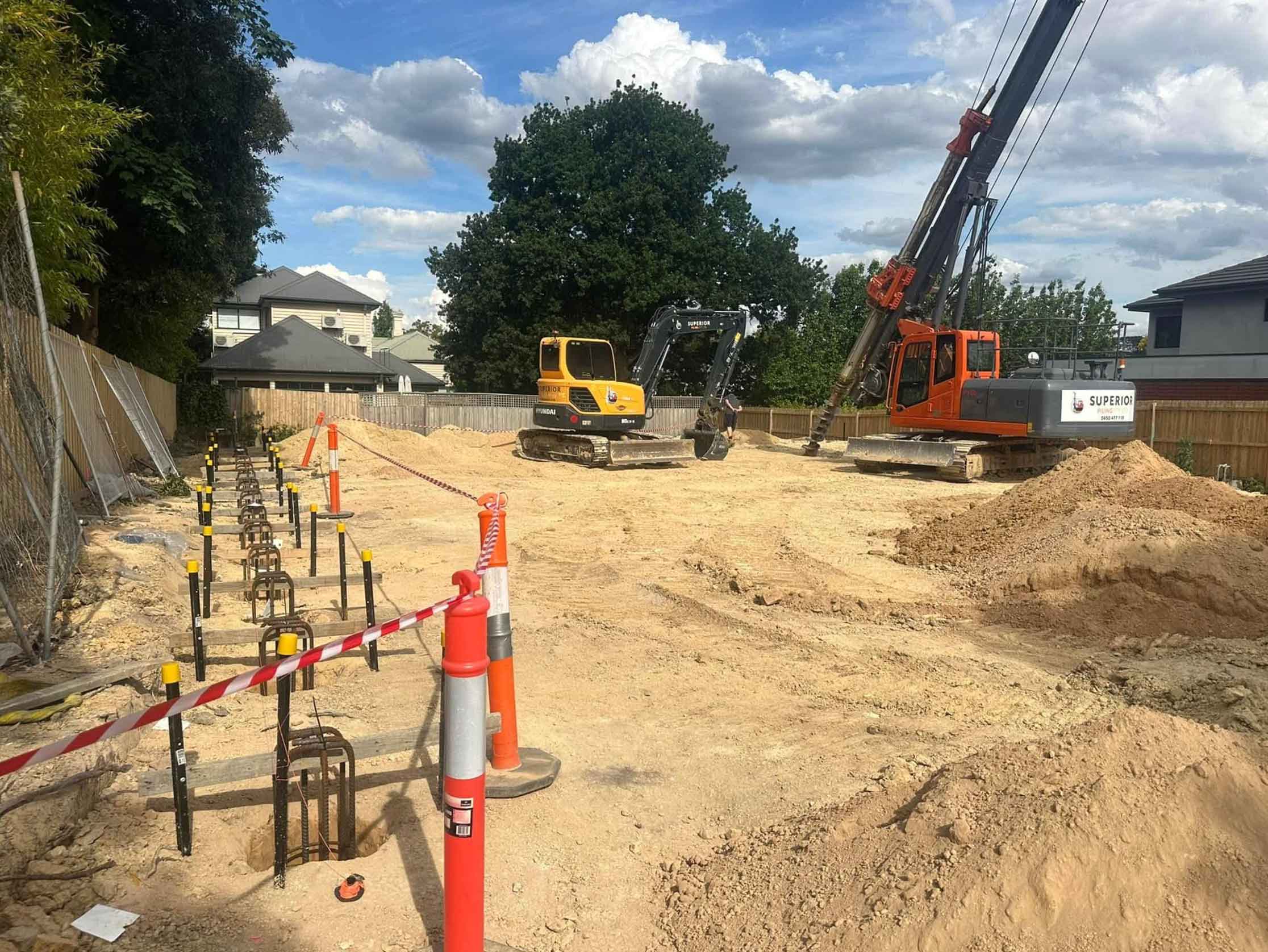
Not every construction site needs piling. But when ground conditions, structural loads or site constraints make standard footings unsuitable, piling can provide the deeper foundation support a project needs.
Across Melbourne, piling is commonly used on residential, commercial and civil construction projects where stable ground is deeper below the surface. From reactive clay and sloping blocks to tight-access sites and heavy structural loads, the right piling system can make a big difference to how a project comes together.
At Superior Land Excavations, we work with builders, developers and property owners across Melbourne to deliver practical piling solutions based on the actual conditions of the site. Our experience with screw piles, bored piers, capping beam, and other piling applications gives us a clear understanding of what needs to be considered before the first pile goes in.
So, when does a construction project need piling?
Standard footings are suitable for many construction projects, but they aren't the right solution for every site.
If the soil near the surface doesn't provide enough bearing capacity, foundations may need to extend deeper to reach more suitable ground. This is where piling comes into play.
Piles transfer structural loads through weaker upper soil layers and into deeper, more stable ground. The required piling system, depth and spacing are determined by the project's engineering requirements and ground conditions.
Piling may be considered when:
The important thing is to identify these conditions early. Getting the foundation solution right from the start can help avoid headaches further down the track.
Melbourne has a mix of ground conditions, and experienced builders know that what's happening below the surface can vary significantly from one site to the next.
Reactive clay is a common consideration across many parts of Melbourne. These soils can expand and contract as moisture levels change, creating movement that needs to be accounted for in foundation design.
Other sites can involve fill, loose soils, sand, dense clay or rock at varying depths.
That's why piling isn't a one-size-fits-all job.
The soil profile, groundwater, structural loads, pile depth, access and engineering specifications all need to be considered before deciding on the right approach.
Our team works with the available site information and engineering requirements to determine the practical piling method for the job.
Sloping sites can present a different set of challenges for builders.
A significant fall across a block can make conventional foundations more complicated and may require additional support to deal with changes in ground level. Excavation and retaining requirements can also increase the amount of groundwork involved.
Piling can be used as part of a foundation or retention system on sloping sites, helping transfer loads into suitable ground and support structures where required.
This is particularly relevant for residential developments, extensions, townhouse projects and other builds where the site needs to be cut, retained or stepped.
Getting the piling and excavation sequence right is important here. The groundwork needs to work with the overall construction plan rather than becoming a bottleneck once the build gets underway.
Screw piles are commonly used where speed, access and minimal ground disturbance are important considerations.
They are installed by rotating steel piles into the ground using hydraulic equipment. Compared with traditional excavation-based foundation methods, screw piling can minimise spoil and reduce the amount of disturbance around the work area.
This can make screw piles a practical option for:
For Melbourne's inner suburbs, access can be a major factor. Narrow driveways, adjoining properties, existing structures and limited working room can all affect what equipment can get onto a site.
That's where choosing the right piling system and machinery becomes important.
Bored piers are another common deep foundation solution used across Melbourne.
The process involves drilling into the ground to the required depth and diameter before reinforcement and concrete are installed. This creates a substantial load-bearing foundation that can transfer structural loads deeper into suitable ground.
Bored piers are commonly used for:
Bored pier drilling can also be suited to sites where the engineering design calls for specific pier diameters, depths or reinforcement requirements.
The right method comes down to the ground conditions and engineering design, not simply choosing whichever system is easiest to install.
Access is one of the first things we look at when planning piling works.
A site might have suitable ground conditions for a particular foundation system, but if the machinery can't physically get into position, the approach may need to change.
This is common across Melbourne's established suburbs, where blocks can have:
Narrow side access
Existing homes close to boundaries
Adjoining properties
Limited rear access
Overhead restrictions
Restricted working areas
Tight-access piling requires the right combination of machinery, planning and site experience.
Our team considers how equipment will enter the site, where spoil and materials can be managed, and how the piling works will fit into the broader construction sequence.
The weight and design of a structure also play a major role in foundation requirements.
A lightweight extension and a multi-level commercial development don't place the same demands on the ground. Larger buildings, multi-storey structures and heavily loaded areas may require foundations capable of transferring significant loads deeper into the soil profile.
Engineers determine the required foundation system based on structural loads and ground conditions. Piling then needs to be installed accurately to those specifications.
For builders, this means the piling contractor needs to understand the engineering requirements and deliver the groundwork properly so the next stage of construction can proceed.
Piling isn't limited to supporting buildings.
It can also form part of retention systems used during excavation, basement construction and projects with significant changes in ground level.
For example, a site requiring a deep basement excavation may need piling and engineered retention to help support surrounding ground during construction.
Piling can also work alongside:
These works need to be properly coordinated because excavation, piling and retention are often closely linked in the construction sequence.
One of the biggest mistakes with piling is leaving it too late in the construction program.
Piling affects access, excavation, machinery requirements, spoil management and the sequencing of other groundwork. Sorting these details early gives builders a clearer picture of how the site will be prepared.
Before piling begins, the key considerations generally include:
Getting these details organised early helps reduce delays and keeps the groundwork moving.
Knowing a project needs piling is one thing. Getting the work done properly is another.
At Superior Land Excavations, our piling team works across Melbourne on residential, commercial and civil projects, handling the practical challenges that come with real construction sites.
We provide screw piling and bored pier drilling in Melbourne, along with piling solutions for retention and structural support. Our approach is straightforward: understand the site, follow the engineering requirements, use the right equipment and get the job done properly.
We know that construction schedules are tight. Builders need contractors who turn up with the right gear, understand the job and keep things moving without unnecessary complications.
If your site has reactive or unstable ground, a significant slope, restricted access, heavy structural loads or substantial excavation requirements, piling may form an important part of the foundation solution. The best starting point is to look at the engineering and ground conditions before construction gets underway.
Superior Land Excavations provides professional piling and excavation services across Melbourne, including screw piles, bored piers and piling solutions for challenging sites.
Planning a project and need piling advice? Contact Superior Land Excavations to discuss your site requirements and arrange a quote.
This article is provided free of charge for public information. We do not guarantee, and accept no legal liability for, the accuracy, reliability, currency, or completeness of the content or any linked material. Users should apply their own judgment and verify the material’s relevance to their needs. This article is a general summary and not a substitute for legal or professional advice. Users should seek appropriate advice for their circumstances. Any third-party views expressed do not necessarily reflect ours or imply endorsement.
Very happy with Superior Excavation. They were professional to deal with and responded to emails and calls promptly. Thanks again for your help. Definitely recommending to my friends.
Very happy with Superior Excavation. They were professional to deal with and responded to emails and calls promptly. Thanks again for your help. Definitely recommending to my friends.
I would like to thank you for your quick and accurate work - excavation of our new house in Ivanhoe. I am very impressed that you prepared the site in two days. It was great dealing with you
Copyright ©2026 superiorlandexcavations.com.au
 IT BOOST AUSTRALIA